
While children all over the world have visions of sugar plums this Christmas, the families of the Gulf Coast region are hoping just to hold their lives together. Four months after deadly Katrina tore apart Louisiana, Mississippi and Alabama, residents are still reeling from lack of appropriate shelter, food and electricity, among other necessities.
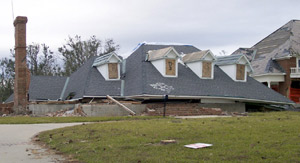 Remains – A roof of a house rests on the foundation of what was once a home in Pascagoula, Miss.
In an effort toward long-term ministry in the Gulf Coast region, the South Carolina Baptist Convention disaster relief ministry has begun a multi-month partnership with the Mississippi Baptist Convention to coordinate relief teams to the coastal Jackson Association. Jackson is the southeastern-most county in Mississippi and sustained severe damage.
Cliff Satterwhite, director of disaster relief, sees the partnership as a way to focus relief efforts “from our state to theirs.”
“The hardest part of recovery is that 35 percent of (evacuated) people never come back,” said Satterwhite.
Satterwhite noted that churches are reeling from diminished ministerial staffs and damaged buildings.
“Right now, it is a victory if a church (in Jackson) can meet together in one place,” he said.
But some churches are realizing those small victories, in part, from the assistance provided from the South Carolina disaster relief volunteers.
Bill and Jane Hightower, volunteers from Fairplay, have agreed to spend the next six months in Mississippi after spending a large part of the past two months coordinating all disaster relief teams working in the area. Bill Hightower brings experience to the assignment; he was director of missions in Charleston when Hugo ravaged the South Carolina coast. The Hightowers’ work frees the associational office to care for badly damaged churches and skeletal church staffs.
To date, South Carolina Baptists have donated nearly $1.8 million to disaster relief, all of which directly benefits the victims. More than $780,000 was allocated to the Mississippi convention to assist victims in that state. After signing the partnership agreement, all donations from South Carolina were given to Jackson Association to be used by disaster relief teams to assist victims.
The association is expecting a rash of activity after the holidays, which may be an ideal time to head to the Gulf Coast. The recovery process is nearing the end of “tear-out mode.”
Trained disaster-relief teams have cleaned most homes of mud and debris. After Christmas, the long rebuilding process can begin. According to the North American Mission Board guidelines for disaster-relief ministry, a person does not necessarily have to be a trained volunteer to participate in the rebuilding process, “which means a lot more people can go to the Gulf at this juncture,” said Satterwhite.
Satterwhite noted that every church should honor previous commitments to other areas in the Gulf region. He said many churches “adopted” other churches in Louisiana and Mississippi.
“We don’t want any church to back out of previous commitments,” he said.
Still, the response to the partnership has been tremendous, he said, with more than 3,000 South Carolina volunteers working in the region to date.
Satterwhite said the partnership will continue through the summer and beyond as teams continue to go.
“The greatest witnessing tool is to spend all day with someone cleaning out their house and them asking you, ‘Why are you here?’ It is then you can share the love of the gospel,” Satterwhite said.
The next disaster-relief training is scheduled for March 3-4 at Spartanburg First Baptist Church and Grace Baptist in Sumter. Identical training sessions will be held simultaneously at both churches.
For more information, or to schedule a team to go to the region, contact the disaster relief office at (800) 723-7242.