
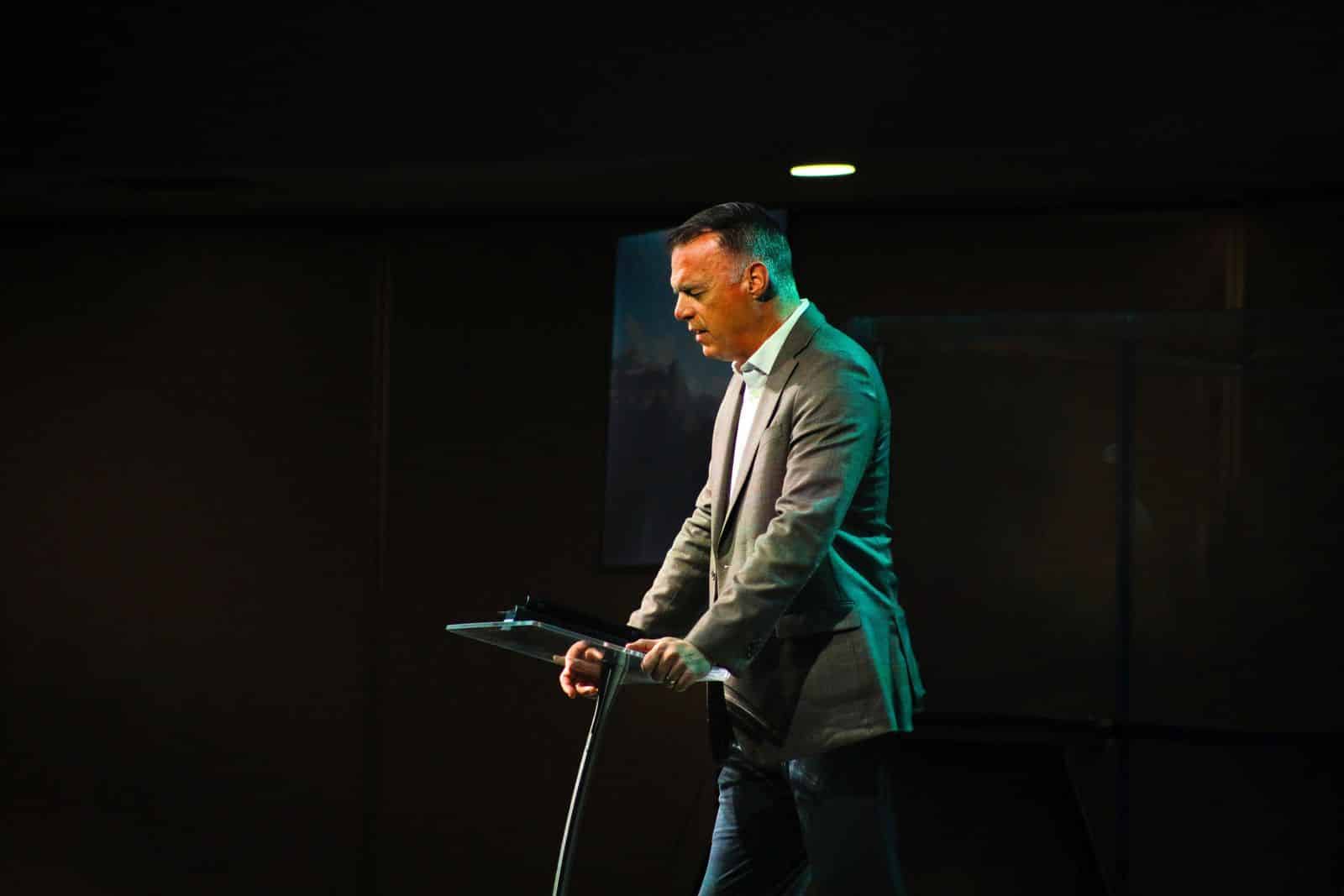

(Editors’ note: This is the extended version of an interview that was published in the June 2026 edition of The Baptist Courier magazine.)
Josh Powell grew up at Red Bank Baptist Church in Lexington where his dad pastored. In fact, Powell is a third-generation Baptist pastor, because his granddad also pastored a Southern Baptist church. Powell made a public profession of faith and was baptized when he was 7 years old, but he doesn’t remember a time when he didn’t believe in Jesus. He said his walk with the Lord is a daily time with Him where he reads, prays, and meditates on God’s Word. Powell attended North Greenville University and graduated in 1998. He also attended The Southern Baptist Theological Seminary and graduated in 2003. Powell pastors at Taylors First Baptist Church, where he’s been the lead pastor since February 2021. He has also pastored a church in Lexington and in Fairdale, Ky., and has served in various leadership roles including president of the South Carolina Baptist Convention and chairman of the board for Southern Seminary and North Greenville University. Powell and his wife, Allison, have been married for over 25 years and have four children: Wilds, Levi, Macy Grace and Paton.
Interview:
Do you have any favorite Scripture passages that have anchored you?
I never have been like a life verse kind of guy. But if somebody asked me, “What’s the verse that has always kind of … I reckon the word would be ‘motivate’ or ‘encourage’ or ‘strengthen’ or ‘give you a shot in the arm’ kind of deal?” It’s always been Acts 20:24, where Paul is speaking to the Ephesian elders and he said, “But I do not account my life of any value nor as precious to myself, if only I may finish my course and the ministry that I received from the Lord Jesus, to testify to the gospel of the grace of God.”
Why would you say that verse specifically?
“No name” disciple has always stuck with me. The idea that ministry is about just serving Christ, exalting His name, and being forgotten. That’s what Spurgeon said. And so, you know Paul says the same thing, “I do not count my life as any value or precious at all.” And so, there’s some sense of which that just rings right with me. There’s nothing in my life of any value or preciousness other than the gospel of Christ and the ministry that He has given me to fulfill.
How do you think that verse applies to you if you get the position as president of the SBC? How do you want to foster that kind of humility when you’re in a public role?
I consider the SBC presidency not as an agenda-driven platform. I don’t think it’s a platform for an agenda. I think the SBC presidency is a stewardship. So, we receive something and we want to steward it the best we can and give it back in a healthier way. So, I would hope that I would steward that role and responsibility as helping us continue the work, the gospel mission, because that’s what we’re all about: the Great Commission. And do it in such a way that brings humility and joy to the position rather than a way that promotes some sort of agenda that I may have in and of myself. I’m not looking for that. I’m looking to simply say, “Here’s who we are, I want to make us better at what we do and hand us off in a better way.”
To me, that’s the whole idea of, “I do not count my life…” It’s not about me. It’s about the mission. It’s about the work. And so, I want to be able to receive it and hand it off — not so people remember Josh, but so that the work can continue in a faithful way.
What would be your thoughts and feelings if you didn’t make it?
I grew up, like I said, [in] the sports world, very competitive, you want to win. But this is one of those things where you just [have] to put it in the Lord’s hands and trust Him. And so, if I don’t win I just have to chalk it up to [the] providence of God and His sovereignty in this and He knows what’s best — and ‘this is best.’ So, I would have to give it over to the Lord — which … my wife, Allison, and I … have done — and just trust Him.
One former SBC president told me, “You don’t run for president or be nominated for president unless you’re prepared to lose.” And I think that that’s kind of been my mentality. Not that I’m going to lose, but that I’m prepared. That’s fine. And we’ll just see what the Lord does.
Is this something that you’ve wanted to do for a while?
No. I’ve never dreamed that this would be even a possibility. So, I’m still a little struck by it every once in a while. I’m from unincorporated Red Bank, South Carolina. And my dad and my granddad, they’re in the ministry, and they never attained or sought to do something like this. I’ve already been blessed to be able to be SCBC president, have leadership roles. I never dreamed those things would happen. So, I don’t say that “in humility” or [to] try to “settle it down.” I’m just saying that was never a part of my plan. Part of my plan was always go pastor a church, be a faithful pastor. And, by God’s grace, He’s allowed me to do that. This is just something has come up and [I] had several people approach me about it. [I] feel honored and privileged that they would consider me as one who could do it.
Would you say your path to becoming the SBC president has been influenced by a lot of leaders who pulled that out of you versus you aspiring to it, or would you say it’s a little of both?
No, I think it’s been not pulled out of me. [But] I consider my relationships — my friendships, my pastor friends, those trusted people in my life — as vitally important. And when they encourage me and tell me, “You can do this” or “We see this in you,” I take that very seriously…
And my other part of it has always been if Southern Baptists who birthed me, raised me, and educated me — I mean, I’ve been receiving a salary from Southern Baptists for 30 years — so if they come to me and say, “We want you to do something” or “We would like for you to do this,” my answer has always been yes.
So, from serving on the board at Southern Seminary, to serving on the board at [the] South Carolina Baptist Convention, to being the chairman of the board at Southern Seminary and North Greenville, and to being president of the SCBC … all of those things I never attained to, I never asked. I never went to any president and said, “I want to be the chairman.” Never did any of that. [T]hey’d come to me and say, “Will you do this?” and my answer has always been if Southern Baptists asked me to do something, then I’m going to say yes. Because I owe so much to Southern Baptists and what they’ve meant to me and how they’ve invested in my life.
Are there any specific leaders who have really encouraged you in this, or who have mentored you, or just been an encouragement to you in your faith?
I don’t think there’s anyone specific. I mean, all of my friends are … Baptist, and so I think there’s just been a group of pastors … a consistent, faithful group of pastors … who have come to me and consistently spoken into my life, given me advice, and encouraged me in things — and that group is the same [one] that came and encouraged me in this. Then there have been other leaders who stepped in and said, “Man, I think it’d be great.” It’s just mainly been Southern Baptist pastors who are friends and close friends who have encouraged me in the process.
Is there anything that you’re excited about — or, on the flip side of that, nervous about?
Well, obviously there are nerves. I mean, you’re considering leading one of the largest Protestant denominations, if not the largest Protestant denomination in the world. And “leading” — in a way, that’s a little bit misleading. I don’t want to act like the presidency is something that it is not. The presidency is, first and foremost, you’re planning a meeting. And you help preside over that meeting so that Southern Baptists can be heard and we can work through some things. And then secondly, you’re appointing committees. So, we’re doing that. And then you do have some influence and have a little bit of a megaphone to be heard.
So, my excitement and my concern are the same. It is exciting to think that the Lord could possibly use me to help guide and steer, direct, encourage, [and] strengthen Southern Baptists so we can continue our work together through the Great Commission. And it’s also terrifying at the same time. You know what I’m saying? I don’t want to steer that in the wrong direction or let some sense of selfish pride step in the way of it. I want to do it in a way of humility, not in a way of arrogance and pride, or even in some sense of thinking that I know best for everybody. I want to do it in a way that honors the Lord and encourages Southern Baptists. So, I guess the fear and the excitement are the same thing in the path.
How has your view of what it means to be a Southern Baptist grown and been shaped over time?
I always knew what Baptist life was growing up — but as I grew, my knowledge expanded about what it means to be Southern Baptist. Then while I was in seminary, I began to really understand the cooperative nature that we have together. And so, as the mission becomes clear of the Great Commission — and then I’m recognizing that you can’t do that by yourself, you do that with others, you join in together — then I start to see, what I consider, the genius or the beauty of the Southern Baptist system: That we’re pooling our resources so we can send more missionaries on the field, and we can do it better together…
To me, as my understanding of the mission and the vision of the SBC, of the Scriptures, the Great Commission, became clear, then the SBC became even more important to me because now I’m able to do this with others. So, at the heart of it, the best we are as people, as a church, as the convention is reaching the nations with the gospel and planting churches, training pastors. That’s why we cooperate together. Reach the nations with the gospel, plant churches, train pastors. And that mission and vision to expand on the Great Commission through those three things, to me it’s best accomplished together. The SBC, the Cooperative Program, all of that becomes a clear way that we can do that. So I join in happily saying, “All right, let’s go. I want to reach people with the gospel.”
Why would you say the convictional aspect of being a Baptist is important within that cooperation?
If we’re going to send missionaries, we want them to teach and proclaim what we are in agreement with. If we’re going to plant churches, we want them to be planted with the same understanding of doctrinal faithfulness and in our same emphasis that we want to plant them with. If we’re going to train pastors, then we want them to be trained up in the agreement of the doctrine that we hold dear. So, it’s vitally important that we remain clear upon our convictions and our understanding of the Scriptures together, such as the Baptist Faith and Message 2000 that we have. We must remain closely tied to the BF&M 2000, strictly tied to that. I think it’s a great document that helps us see a broader thing. It allows for some nuance on tertiary issues, especially — but clarity, strong clarity, on primary and secondary doctrines for us …
And so, we have to remain convictionally faithful if we’re going to send missionaries that we trust, plant churches that we trust, and train pastors that we trust.