|
Courier Publishing
Filter by:
Some Christians, while firmly affirming the doctrine of bodily resurrection, unwittingly leave no place for it within their broader theological framework. Many hold that at the moment of death, believers receive their glorified bodies and immediately enter their final,... Continue Reading »
The biblical view of wisdom has some things in common with secular ideas of wisdom, but the differences are also profound. A simple definition of wisdom is “the ability to use knowledge and experience to make good choices and... Continue Reading »
Understandably, when Christians are asked to complete the sentence “God is ____,” virtually all will respond with “love” (1 John 4:8) rather than “a consuming fire” (Heb. 12:29). Yet, both are profoundly biblical — even essential to the Christian... Continue Reading »
One of the more challenging aspects of the Christian apologetic task is defending Christianity against the objection that the gospel is exclusivist. Christian exclusivism means that the Christian faith is the only true faith, that Jesus Christ is the... Continue Reading »
In the creation account in Genesis 1 and 2, God deliberately distinguished human beings from all other beings as His crowning work. He created humans only after everything else, setting the stage for man’s grand entrance. He assigned humans... Continue Reading »
The Bible specifically states in both Testaments that human beings are made in the image of God (Gen. 1:26, 27; 5:1, and 9:6; 1 Cor. 11:7; Col. 3:10; and James 3:9). Even though explicit statements concerning God’s image in... Continue Reading »
The intermediate state is a person’s condition between physical death and the resurrection. For the believer, it is a time of conscious bliss in the presence of the Lord; but for the unbeliever, it is a time of conscious... Continue Reading »
The official doctrine of the Church of Jesus Christ of Latter-Day Saints (Mormons) is that both God the Father and God the Son have physical bodies. Mormons also believe that there exists a heavenly mother who is the wife... Continue Reading »
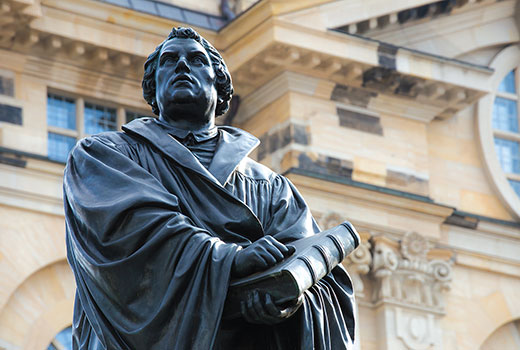
The Protestant Reformation was a movement in 16th-century Europe that began as an attempt to reform the beliefs and practices of the Roman Catholic Church. When it became apparent that reforming the Church was impossible, the Reformers separated from... Continue Reading »
Philosopher Frederick Copleston asked atheist philosopher Bertrand Russell what Russell would say if, after death, he faced God who asked him why he didn’t believe. Russell responded, “I would say, ‘Not enough evidence, God; not enough evidence.’” This exchange... Continue Reading »
Is Jesus the only Savior? Are there many paths to God and to salvation? These questions raise the issue of religious pluralism — the idea that all religions, at least the ethical ones, lead to God and salvation. Often... Continue Reading »
The fourth commandment says, “Remember the Sabbath day to keep it holy.” Since the Sabbath is the seventh day of the week, why, then, do Christians worship on Sunday, the first day of the week? The question is all... Continue Reading »
Sign Up For Email Alerts